Human Factors
Did you know that over 80% of aviation incidents relate to human factors? You as a pilot are more likely to commit a fatal error than your engine quitting. Therefore, we should heavily emphasize understanding Human Factors when learning about flying
Going IMC (instrument meteorological conditions) can confuse the body and mind, leading you to make decisions that aren't grounded in reality. A pilot who wants to be safe, needs to understand these sensations to counteract them when they arise.
In this post we will cover sensory systems and illusions in flight. To read about psychological, physiological, medical factors, ADM, and CRM- please click on their respective links to be redirected
Sensory Systems
Our ability to orient ourselves in space is entirely dependent on our sensory organs. When we lose information from these sensory organs, our brain gets confused and begins to hallucinate sensations and visualizations that don't truly exist. This is unlikely in every day life, but when the human body is subjected to the forces of flight, disorientation can be commonplace.
Eyes
Of all our sensory organs, the eyes provide the most amount of information to maintain a safe flight condition. Our eyes work similar to a camera, we have a lens that focuses light to excite neurons which then send electrical signals to our brain which we interpret as an image.
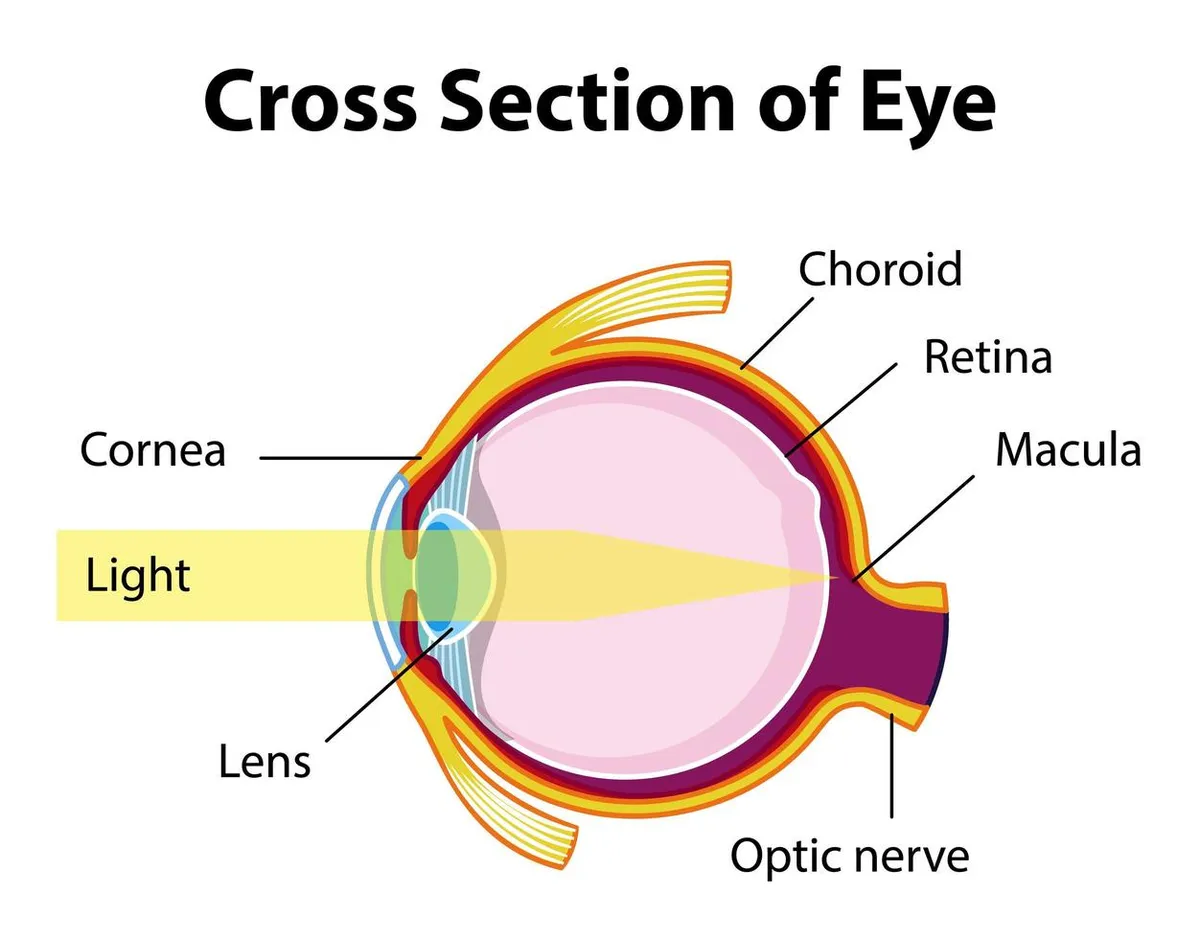
We have two types of receptors in our eyes. Cones, for daytime and color vision are located in our fovea (the center of our eye) and account for only 5% of the total receptor cells. Rods, are responsible for nighttime vision and are primarily located in our periphery. Rods account for the rest of the 95% of receptor cells.
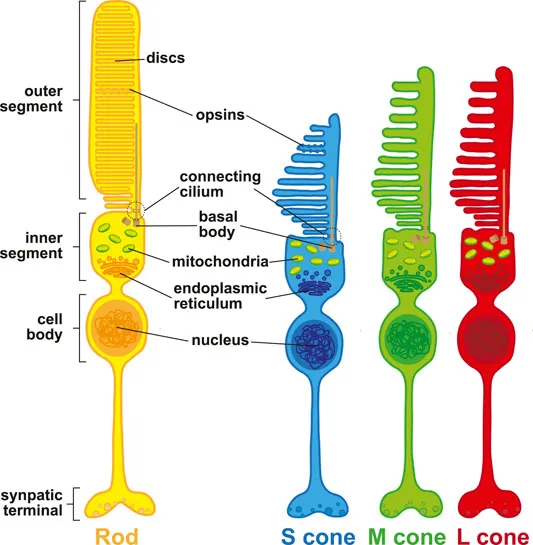
Its important to understand that the different type of receptor cell is tuned to either daytime vision (cones) or nighttime vision (rods). Cones are ineffective at producing accurate images at nighttime and rods are ineffective at producing accurate images during daytime.
To put it simply, our receptor cells use chemical pigments to detect when light has hit them. The pigment then excites the neuron connected to the receptor cell which our brain can interpret as visual information. Rods are much more sensitive to light than cones and can have their pigment completely "stripped" by being exposed to too much light, leaving the cell unable to detect light for a short time. This is why you get a temporary blind spot in your vision when you shine a light directly into your eye. It takes a while for the chemical pigment to regenerate in your eye, but eventually the blind spot goes away. As pilots, we must be careful around bright lights when planning to fly at nighttime. Exposing ourselves to too much light can compromise our ability to spot traffic, read instruments, or set up for approach. The FAA suggests that you avoid bright lights 30 minutes prior to night time flight, and even wear sunglasses during sunset to protect your night vision capabilities.
Additionally, our eye has two permanent blind spots: a daytime blind spot, and a nighttime blind spot. The optic nerve that takes all the data from our cones and rods and sends it to the brain leaves the eye through the back of the retina. This creates our daytime blind spot where no cones or rods exist to create electrical signals, and therefore no visual information. The blind spot is very small in our visual field, approximately 0.1-0.3% of our total visual field.
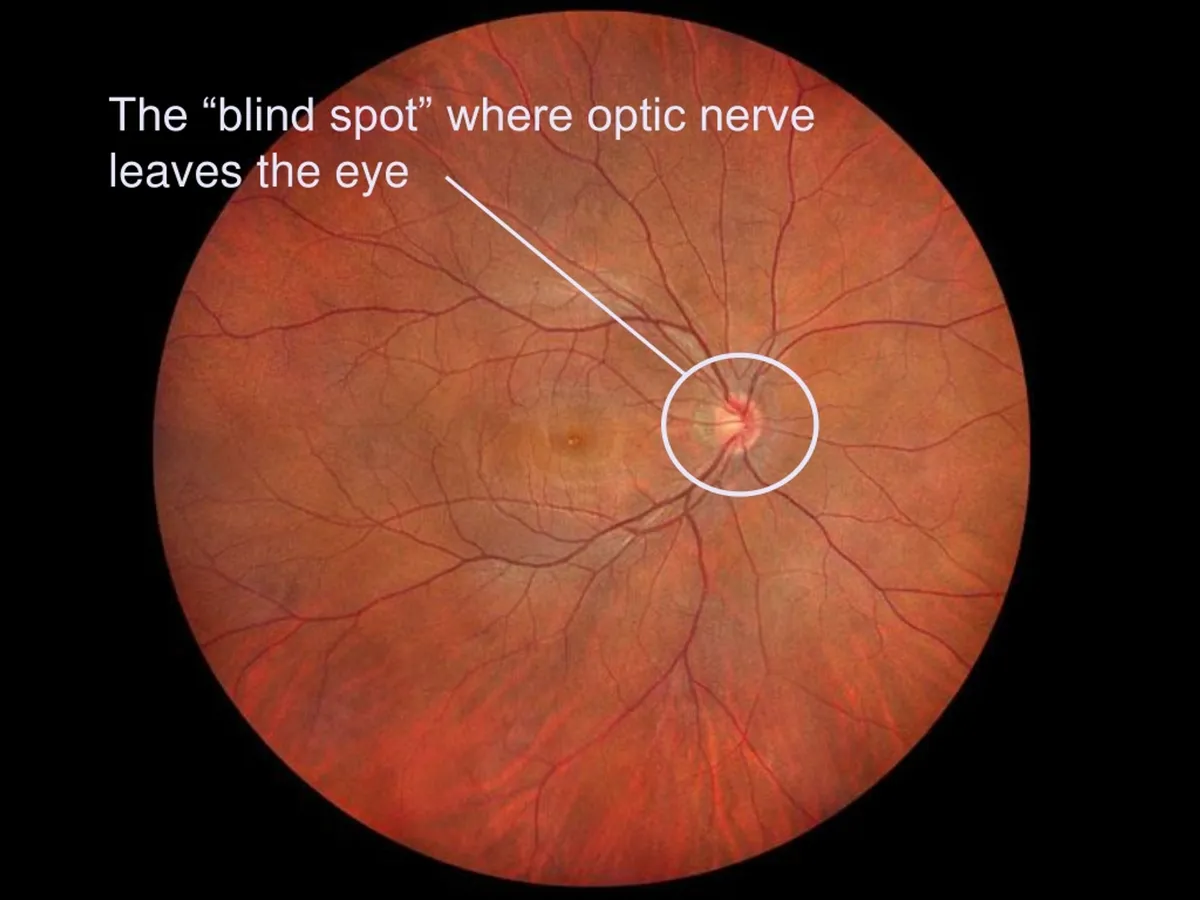
Take a break from reading and look around. Can you identify your blind spot? No? Good! Your brain is actively interpreting the visual data from around your blind spot and filling the blind spot in. It would be pretty annoying if we had a hole in our vision that we could always "see" (you can't really see something that is a product of a lack of detector cells). As a side note, if you want to "see" your blind spot, check out this YouTube video.
More important to us as pilots is the nighttime blind spot. The night blind spot exists because of the location of our rods and cones. Remember, our cones (color vision) primarily exist in our fovea (the center of our vision) meaning there are very few rods (nighttime vision) in our fovea. This means that our night blind spot is the center of our vision. Of course, we can still detect light information in the fovea, but it is very reduced in quality and capability. Therefore, we need to use off-center viewing and scanning at night. To read more about scanning please check out the AIM Section 8-1.
Ears
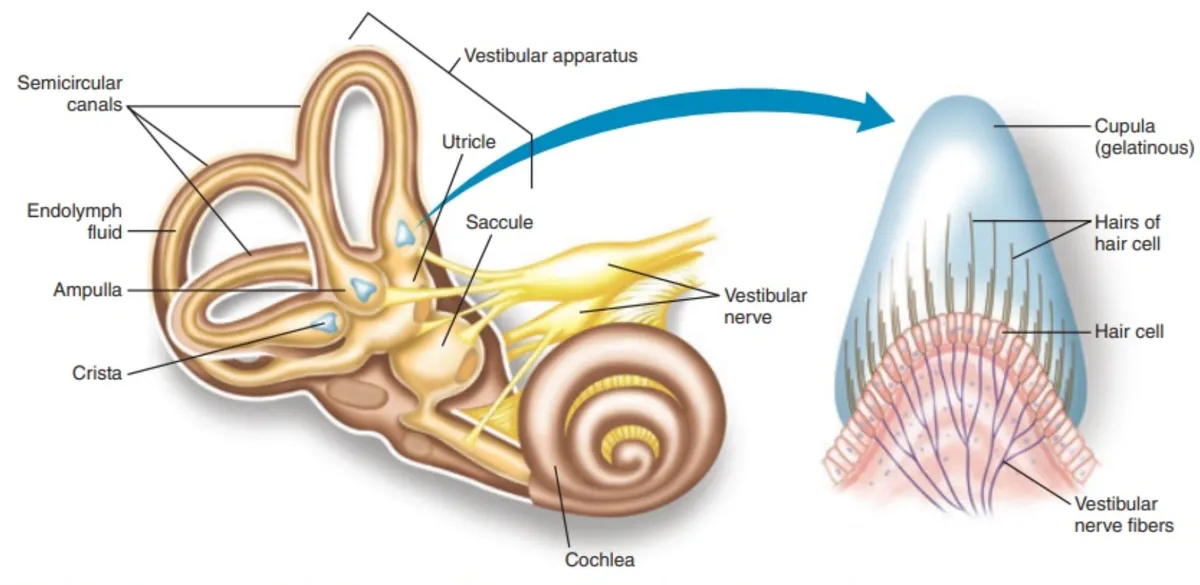
Your ears aren't just for hearing. They are also responsible for your bodies sense of orientation in space. The inner ear has two parts concerned with orientation: the semicircular canals and the otolith organs.
The semicircular canals detect angular acceleration and gravity. They are made up of three different tubes oriented at right angles to each other and placed in the x, y, and z planes. Each canal is filled with a fluid called endolymph. At the base of the canals are ampullae that hold cupolas. A cupola is a collection of sensory hairs that live in a gelatin casing. When your head pitches, yaws, and rolls, it is the motion of the endolymph fluid pushing against the cupolas that transmits electrical signal to your brain and conveys sensations of motion.
Nerves
Illusions
BODY