Main Rotor Systems
If you're starting your PPL(H), one of the first big "aha" concepts is realizing that not all rotor heads work the same way. The R22 you're flying has a specific design with specific quirks, but to really get why it's built that way, it helps to see it next to the other two designs. So let's break down the three classifications: semirigid, fully articulated, and rigid. A little bit of context and definitions to help your learning before we dive in: every rotor system has to deal with three kinds of blade motion; flapping (up/down), feathering (twisting to change pitch), and lead/lag (speeding up/slowing down in the plane of rotation). The difference between rotor types boils down to how these three challenges are solved. Either through hinges, through bending, or some mix.
Semi-rigid Rotor System
The semi-rigid rotor system is used in the Robinson R22 and R44, so it's worth really internalizing and understanding its nuances. A semi-rigid system is usually two blades, rigidly bolted to the hub where the hub itself is free to tilt on a single teetering hinge (sometimes called a flapping hinge). Think of it like a seesaw: as one blade flaps up, the other flaps down, because they're mechanically linked as a rigid unit through that single fulcrum point.
The semi-rigid rotor system has no separate lead/lag hinge so any lead/lag forces just get absorbed by the blades flexing. There is no additional hardware needed to handle that motion. There is a feathering hinge, though, which lets the pitch angle change. On the R22 and R44 the feathering hinge sits inside of the blade root and is connected to the pitch links with a pitch horn. Check out the photo below for a better idea of the specific components.
photo of R22 rotor mast, take it yourself and label only feathering hinge
The R22's rotor varies slightly in design from a traditional semi-rigid rotor system by being "underslung," meaning the hub's center of gravity sits slightly below where it physically attaches to the mast. Here's how I think of it to help my understanding: imagine a pendulum hanging from a fixed point. No matter how the pendulum swings, the distance from the pivot to the bob's center of mass stays the same. A semi-rigid underslung rotor system does the same geometric trick for the rotor. When the blades flap/teeter, their combined center of mass stays at roughly the same spot relative to the mast, instead of swinging around and creating wobble. Here's what I would memorize for your stage check: an underslung rotor system keeps the CG anchored relative to the mast through flapping, which eliminates geometric imbalance.
The semi-rigid underslung rotor system isn't perfect though. It is notoriously known for mast bumping. Since the hub is solid-mounted but can teeter, there's a hard mechanical limit to how far it can flap. Exceed that limit and the static stop (a metal component meant to limit travel) can slam into the mast itself. When we're flying straight-and-level the blades are only flapping about 2°. But low rotor RPM, high gross weight, high density altitude, turbulence, or aggressive low-speed maneuvering can all increase that flapping angle. If it exceeds the design limit, you get violent static-stop-to-mast contact, which can shear the mast. Mast bumping is more times than not deadly and is must-avoid territory, we as pilots must be aware of the circumstances in which mast-bumping occurs and how we can avoid it during flight.
You might be wondering "Why are semi-rigid underslung systems used?" if there are life threatening tradeoffs to their design, and its a good question to break down. Even though mast-bumping is a serious concern, when made aware of the conditions that cause mast-bumping, the risk is nearly zero (this is part of the reason why the SFAR 73 is so important!!!) Additionally, having only two blades and a simple design makes the semi-rigid underslung rotor system cheap to build and maintain and easy to hangar. The tradeoff is that control response is a bit less crisp than an articulated system, and vibration can run a little higher.
photo of r22 rotor mast with all components labeled
Fully Articulated Rotor System
The fully articulated rotor system is what is most commonly found on most multi-blade helicopters (anything with 3 or more main rotor blades). The key difference from a semi-rigid underslung rotor system is that each blade gets its own independent hinges: a flapping hinge, a feathering hinge, and a lead/lag (drag) hinge.
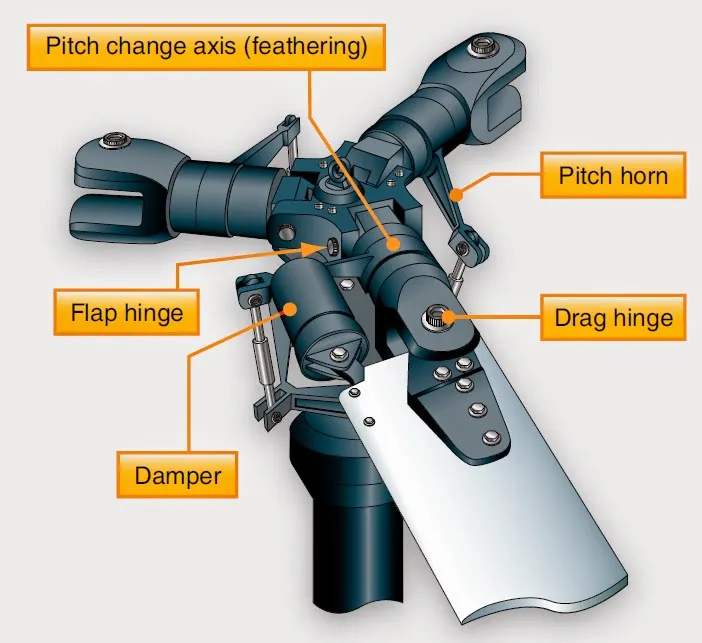
Because each blade flaps independently, each individual blade also needs its own way of dealing with lead/lag. Here's how I think of it to help the concept click: think of a figure skater spinning. When he/she pulls their arms in, their moment of inertia drops and they spin faster (conservation of angular momentum). When they extend their arms, they slow down. A rotor blade does the exact same thing as it flaps. When it flaps up, its effective CG shifts slightly inward toward the hub, its moment of inertia changes, and it wants to speed up or slow down relative to the rest of the rotor system. The lead/lag (drag) hinge is what lets the blade speed up/slow down (leading and lagging). Here's the most basic concept that you need to know for your stage check: flap changes a blade's cg → changes its inertia → blade leads or lags to conserve momentum.
Fully articulated rotor systems have the advantage of great control response, since each blade can react independently. However their main disadvantage is that more hinges = more complexity. Which means more parts, more maintenance, and higher aerodynamic drag than a two-bladed rotor head.
Rigid Rotor System
The rigid rotor system is the "what if we just... didn't have hinges" approach. The blade roots are bolted straight to the hub so no flapping hinge and no lead/lag hinge. So how does it handle the stress of flight? The blades themselves flex and bend to absorb the loads that hinges would normally take care of. They can still feather (change pitch), just not flap or lead/lag through a mechanical hinge/joint.
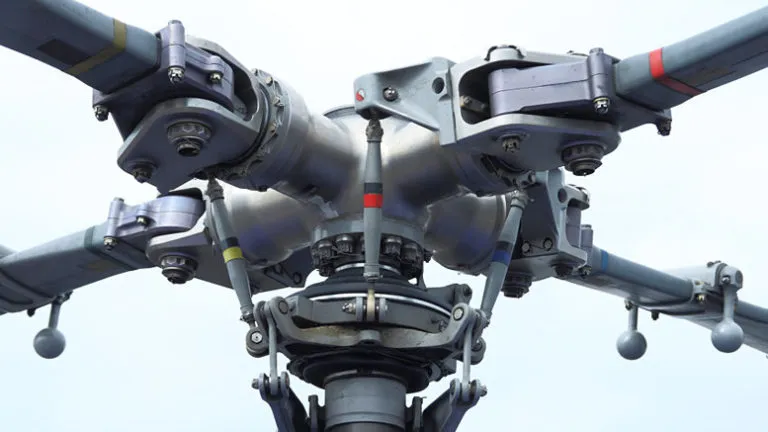
Because the hub is solid-mounted to the mast, the rotor and fuselage move together as one unit. Therefore, rigid rotor systems aren't vulnerable to mast bumping the way a semi-rigid underslung system is. No teetering hinge means there's no hinge limit to exceed in the first place.
Rigid rotor systems have the advantage of being mechanically simple (fewer hinges = fewer failure points and easier maintenance), very crisp/responsive control feel, and a bigger "flapping arm" effect that reduces how much control input is needed. That being said, all of the structural loads that used to get absorbed by hinges now get absorbed by the blade material itself, which means a rougher ride in turbulence. The vibrations transmit straight into the cabin instead of being soaked up by a hinge. This is why you won't typically see rigid rotor systems on passenger helicopters.
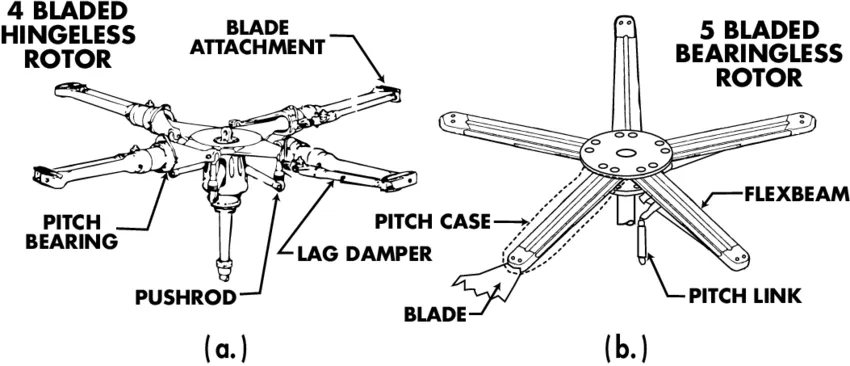
Side note: you'll also run into the bearingless rotor, which is a cousin of the articulated and rigid designs. The bearingless rotor system has no hinges or bearings, just a composite structure flexible enough to handle all three motions through material flex alone.
Summary & Quiz
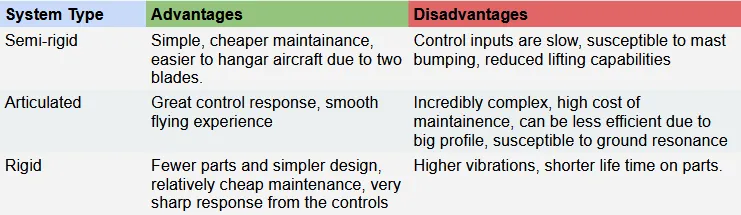
To wrap up main rotor systems, I've created a table to show the advantages and disadvantages of each system as well as a set of flash cards and quiz. When preparing for your check ride/stage check its primarily important to understand the three problems that rotor systems solve; flapping, feathering, and lead/lag. Each rotor system is solving these problems in a slightly different way and trading off simplicity and therefore maintenance costs.